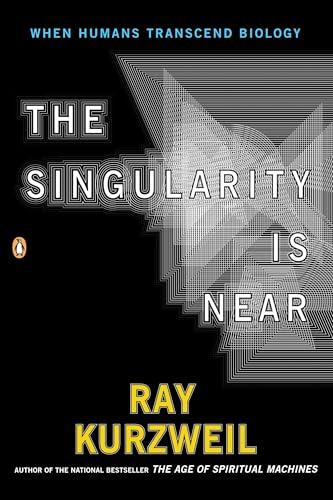
The Singularity Is Near: When Humans Transcend Biology

Product Description
The Singularity Is Near: When Humans Transcend Biology
<b><b><b>€œStartling in scope and bravado.€Â €"Janet Maslin, <i>The New York Times</i><br><br>€œArtfully envisions a breathtakingly better world.€Â €"<i>Los Angeles Times</i><br><br><b><b><b>€œElaborate, smart and persuasive.€Â €"<i>The Boston Globe</i></b></b></b><br><br>€œA pleasure to read.€Â €"<i>The Wall Street Journal</i><br><br></b>One of <i>CBS News</i>€s Best Fall Books of 2005 <b><b>€ </b></b>Among <i>St Louis Post-Dispatch</i>€s Best Nonfiction Books of 2005 <b><b>€ </b></b>One of Amazon.com€s Best Science Books of 2005<br><br>A radical and optimistic view of the future course of human development from t</b>he bestselling author of <i>How to Create a Mind </i>and <i>The Age of Spiritual Machines </i>who Bill Gates calls €œthe best person I know at predicting the future of artificial intelligence€Â</b><br><br>For over three decades, Ray Kurzweil has been one of the most respected and provocative advocates of the role of technology in our future. In his classic <i>The Age of Spiritual Machines</i>, he argued that computers would soon rival the full range of human intelligence at its best. Now he examines the next step in this inexorable evolutionary process: the union of human and machine, in which the knowledge and skills embedded in our brains will be combined with the vastly greater capacity, speed, and knowledge-sharing ability of our creations.
Technical Specifications
You might also like

How to Create a Mind: The Secret of Human Thought Revealed
—

The Age of Spiritual Machines: When Computers Exceed Human Intelligence
—

Superintelligence: Paths, Dangers, Strategies
—

Abundance: The Future Is Better Than You Think (Exponential Technology Series)
—

Life 3.0: Being Human in the Age of Artificial Intelligence
—

The True Believer: Thoughts on the Nature of Mass Movements (Perennial Classics)
—

Transcend: Nine Steps to Living Well Forever
—

The Denial of Death
—

Danielle: Chronicles of a Superheroine
—

Our Final Invention
—