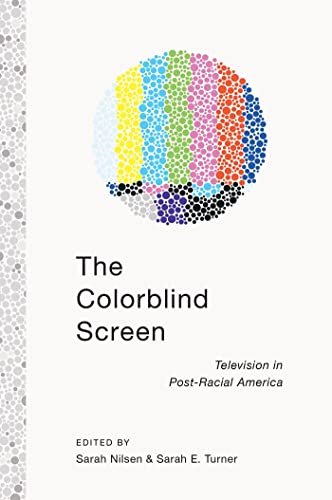
The Colorblind Screen: Television in Post-Racial America
Product Description
The Colorblind Screen: Television in Post-Racial America
<p>The election of President Barack Obama signaled for many the<br />realization of a post-racial America, a nation in which racism was no longer a<br />defining social, cultural, and political issue. While many Americans espouse a<br />“colorblind†racial ideology and publicly endorse the broad goals of<br />integration and equal treatment without regard to race, in actuality this<br />attitude serves to reify and legitimize racism and protects racial privileges<br />by denying and minimizing the effects of systematic and institutionalized<br />racism.</p><br /><p>In <em>The Colorblind Screen</em>, the contributors examine<br />television’s role as the major discursive medium in the articulation and<br />contestation of racialized identities in the United States. While the dominant<br />mode of televisual racialization has shifted to a “colorblind†ideology that<br />foregrounds racial differences in order to celebrate multicultural<br />assimilation, the volume investigates how this practice denies the significant<br />social, economic, and political realities and inequalities that continue to<br />define race relations today. Focusing on such iconic figures as President<br />Obama, LeBron James, and Oprah Winfrey, many chapters examine the ways in which<br />race is read by television audiences and fans. Other essays focus on how visual<br />constructions of race in dramas like <em>24</em>, <em>Sleeper Cell</em>, and <em>The Wanted</em><br />continue to conflate Arab and Muslim identities in post-9/11 television. The<br />volume offers an important intervention in the study of the televisual<br />representation of race, engaging with multiple aspects of the mythologies<br />developing around notions of a “post-racial†America and the duplicitous<br />discursive rationale offered by the ideology of colorblindness.</p>
Technical Specifications
You might also like

ASUS ROG Strix LC III 360 All-in-one CPU Liquid Cooler with 360° rotatable Water Block, Asetek’s New Gen7 v2 Pump, Premium ROG Fans, and 10+ Custom Aura Lighting Effects

Europe Map - 16.5 x 23.3 Inches - Paper Laminated

Star Wars A New Hope Vintage Poster Adult T-Shirt - Black (XX-Large)
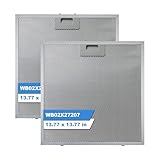
WB02X27207 Range Hood Grease Filters Compatible with GE Range Vent Hood JVX5300BJ1TS JVX5300DJ1BB JVX5300DJ1WW Replace For 4463981 PS11771771 EAP11771771-2 Pack 13.77 x 13.77 x 0.39 Inches
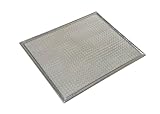
Appliance Grease Filter Compatible with Jenn-Air Model Numbers C202, C202-C, C203, C203-C, C206, C206B, C206B-C, C206-C

SUPPLYZ Direct Replacement for GE WB08X10039 Range Hood Bezel 1085475 AH952781 EA952781 PS952781

EvertechPRO W11213882 Charcoal Filter for Whirlpool and Kitchen Aid Microwave Range Hood Models 2 Pack
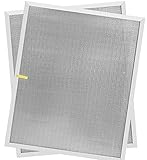
Fietrexa BPS1FA30 Range Hood Filter Aluminum Grease Filter 11-3/4 x 14-1/4" x 3/8" Replacement for Broan QS1 30" and Nutone Allure 30" WS1 Pack of 2