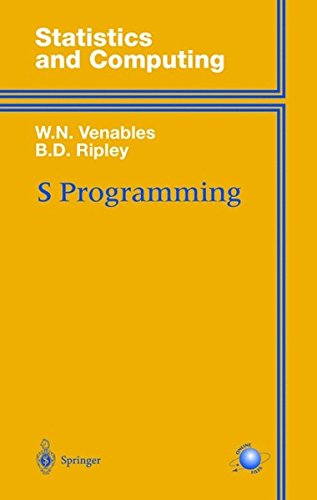
S Programming (Statistics and Computing)
Product Description
S Programming (Statistics and Computing)
- ISBN13: 9780387989662
- Condition: New
- Notes: 100% Satisfaction Guarantee. Tracking provided on most orders. Buy with Confidence! Millions of books sold!
<P>S is a high-level language for manipulating, analysing and displaying</P> <P>data. It forms the basis of two highly acclaimed and widely used data</P> <P>analysis software systems, the commercial S-PLUS® and the Open</P> <P>Source R. This book provides an in-depth guide to writing software in</P> <P>the S language under either or both of those systems. It is intended</P> <P>for readers who have some acquaintance with the S language and want to</P> <P>know how to use it more effectively, for example to build re-usable</P> <P>tools for streamlining routine data analysis or to implement new</P> <P>statistical methods.</P> <P></P> <P>One of the outstanding strengths of the S language is the ease with</P> <P>which it can be extended by users. S is a functional language, and</P> <P>functions written by users are first-class objects treated in the same</P> <P>way as functions provided by the system. S code is eminently readable</P> <P>and so a good way to document precisely what algorithms were used, and</P> <P>as much of the implementations are themselves written in S, they can be</P> <P>studied as models and to understand their subtleties. The current</P> <P>implementations also provide easy ways for S functions to call</P> <P>compiled code written in C, Fortran and similar languages; this is</P> <P>documented here in depth.</P> <P></P> <P>Increasingly S is being used for statistical or graphical analysis</P> <P>within larger software systems or for whole vertical-market</P> <P>applications. The interface facilities are most developed on</P> <P>Windows® and these are covered with worked examples.</P> <P></P> <P>The authors have written the widely used Modern Applied Statistics</P> <P>with S-PLUS, now in its third edition, and several software libraries</P> <P>that enhance S-PLUS and R; these and the examples used in both books</P> <P>are available on the Internet.</P> <P></P> <P>Dr. W.N. Venables is a senior Statistician with the CSIRO/CMIS</P> <P>Environmetrics Project in Australia, having been at the Department of</P> <P>Statistics, University of Adelaide for many years previously.</P> <P></P> <P>Professor B.D. Ripley holds the Chair of Applied Statistics at the</P> <P>University of Oxford, and is the author of four other books on spatial</P> <P>statistics, simulation, pattern recognition and neural networks. Both</P> <P>authors are known and respected throughout the international S and R</P> <P>communities, for their books, workshops, short courses, freely</P> <P>available software and through their extensive contributions to the</P> <P>S-news and R mailing lists.</P> <P></P>
Technical Specifications
Customers who bought this also bought
You might also like
Software for Data Analysis: Programming with R (Statistics and Computing)

The Art of R Programming: A Tour of Statistical Software Design
Programming with Data: A Guide to the S Language (Lecture Notes in Economics and)
Modern Applied Statistics with S (Statistics and Computing)

R Cookbook (O'Reilly Cookbooks)