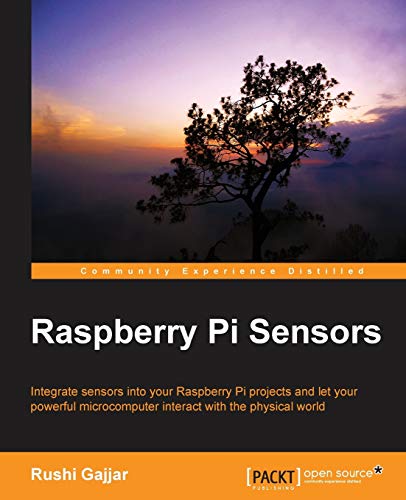
Raspberry Pi Sensors
Product Description
Raspberry Pi Sensors
<p><b>Integrate sensors into your Raspberry Pi projects and let your powerful microcomputer interact with the physical world</b></p> <h2>About This Book</h2><ul><li>Learn how to apply sensors to your Raspberry Pi board to create impressive interactive projects</li><li>Dig deeper into your Raspberry Pi using Linux and Python</li><li>Get to grips with a range of exciting libraries, including OpenCV, and use them to power your projects</li></ul><h2>Who This Book Is For</h2><p>This book is perfect for hardware enthusiasts who want to develop amazing projects using Raspberry Pi. Some knowledge and experience working with Linux, C, and Python is a plus, but once you're set up to go, you'll be ready to push the creative capabilities of your Raspberry Pi even further.</p><h2>What You Will Learn</h2><ul> <li>Set up your Raspberry Pi board and integrate it with powerful sensors</li> <li>Discover how to operate your Raspberry Pi by exploring its Linux-based OS</li> <li>Develop a deep understanding of your Raspberry Pi's GPIOs and access them through Python, C, and shell scripting</li> <li>Create an ultrasonic distance meter and use it to make an aid for visually impaired or blind people</li> <li>Interface a temperature-humidity sensor and photocells together with your Raspberry Pi to log the data</li> <li>Find out how to upload the data you collect online and receive regular notifications of irregularities</li> <li>Integrate OpenCV with your Raspberry Pi and learn how you can master the latest in image processing technology with the power of computer vision</li> </ul><h2>In Detail</h2><p>The tiny Raspberry Pi device contains the power to revolutionize the way we understand computing. Built with a Linux-based operating system, it is a tool that invites exploration and experimentation, and can be repurposed and integrated with other hardware and software to help create some truly exciting projects.</p><p>With Raspberry Pi Sensors you will learn how to get more from your Raspberry Pi and dive deeper into its engineering by exploring its Linux-based OS before learning how to develop and execute programs on it using Python and C. You'll then find a range of projects like creating your own ultrasonic sensor to monitor the atmosphere, connect your Raspberry Pi to the Internet so you can upload data online and use it as a launchpad to create Internet of Things based projects. Learn how to create your own image sensor using a simple USB camera and the innovative OpenCV library to perform motion detection.</p>
Technical Specifications
You might also like
Programming the Raspberry Pi, Second Edition: Getting Started with Python

Exploring Raspberry Pi: Interfacing to the Real World with Embedded Linux

Raspberry Pi IoT Projects: Prototyping Experiments for Makers

Raspberry Pi Cookbook: Software and Hardware Problems and Solutions
Make: Sensors: A Hands-On Primer for Monitoring the Real World with Arduino and Raspberry Pi

Learn Robotics with Raspberry Pi: Build and Code Your Own Moving, Sensing, Thinking Robots

Hacking Electronics: Learning Electronics with Arduino and Raspberry Pi, Second Edition
Programming Arduino: Getting Started with Sketches, Second Edition (Tab)

Raspberry Pi User Guide, 4th Edition
Raspberry Pi Projects for the Evil Genius