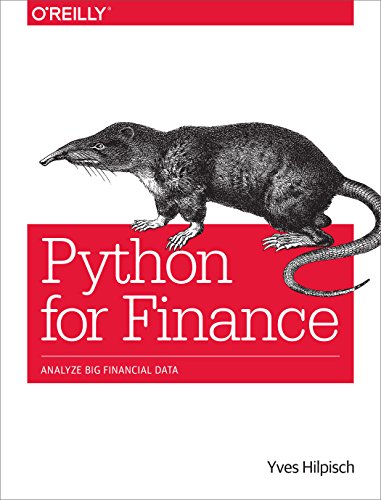
Python for Finance: Analyze Big Financial Data
Product Description
Python for Finance: Analyze Big Financial Data
<div><p>The financial industry has adopted Python at a tremendous rate recently, with some of the largest investment banks and hedge funds using it to build core trading and risk management systems. This hands-on guide helps both developers and quantitative analysts get started with Python, and guides you through the most important aspects of using Python for quantitative finance.</p><p>Using practical examples through the book, author Yves Hilpisch also shows you how to develop a full-fledged framework for Monte Carlo simulation-based derivatives and risk analytics, based on a large, realistic case study. Much of the book uses interactive IPython Notebooks, with topics that include:</p><ul><li><b>Fundamentals:</b> Python data structures, NumPy array handling, time series analysis with pandas, visualization with matplotlib, high performance I/O operations with PyTables, date/time information handling, and selected best practices</li><li><b>Financial topics:</b> mathematical techniques with NumPy, SciPy and SymPy such as regression and optimization; stochastics for Monte Carlo simulation, Value-at-Risk, and Credit-Value-at-Risk calculations; statistics for normality tests, mean-variance portfolio optimization, principal component analysis (PCA), and Bayesian regression</li><li><b>Special topics:</b> performance Python for financial algorithms, such as vectorization and parallelization, integrating Python with Excel, and building financial applications based on Web technologies</li></ul></div>
Technical Specifications
You might also like

What Hedge Funds Really Do: An Introduction to Portfolio Management
Python for Data Analysis: Data Wrangling with Pandas, NumPy, and IPython
Web Scraping with Python: Collecting Data from the Modern Web

Hands-On Machine Learning with Scikit-Learn and TensorFlow: Concepts, Tools, and Techniques to Build Intelligent Systems

Python Data Science Handbook: Essential Tools for Working with Data

Algorithmic Trading: Winning Strategies and Their Rationale (Wiley Trading)
Machine Trading: Deploying Computer Algorithms to Conquer the Markets (Wiley Trading)
Introduction to Machine Learning with Python: A Guide for Data Scientists
Building Winning Algorithmic Trading Systems: A Trader's Journey From Data Mining to Monte Carlo Simulation to Live Trading (Wiley Trading)