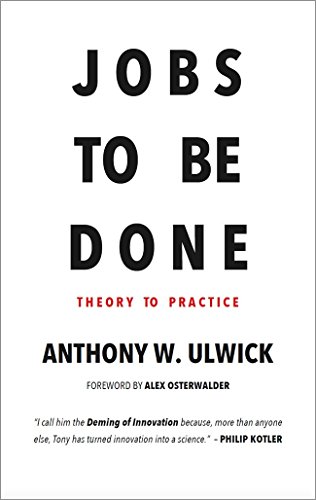
Jobs to be Done: Theory to Practice
Product Description
Jobs to be Done: Theory to Practice
<b>Why do so many innovation projects fail?</b> What are the root causes of failure? How can they be avoided? Since 1990, <b>Tony Ulwick</b> has pioneered an innovation process that answers these questions. In 1999, Tony introduced <b>Clayton Christensen</b> to the idea that “people have underlying needs or processes in their lives, that they are addressing in some way right nowâ€â€”an insight that was to become <b>Jobs-to-be-Done Theory</b>. <p>For 25 years, Ulwick and his company, <b>Strategyn</b>, have helped over 400 companies, applying <b>Jobs-to-be-Done Theory</b> in <em>practice</em> with a <b>success rate of 86%</b>—a 5-fold improvement. </p><p>“Ulwick has taken the guesswork out of innovation,†says the ‘father of modern marketing,’ <b>Philip Kotler</b>, S. C. Johnson Distinguished Professor of International Marketing at the Kellogg School of Management, Northwestern University. “He has done this by introducing us to Jobs-to-be-Done theory, and converting it to practice using his rigorous innovation process known as <b>Outcome-Driven Innovation</b>. </p><p>I call him the <b>Deming of Innovation</b> because, more than anyone else, Tony has turned innovation into a science,†adds Kotler.</p><p> <b>LEARN</b><br /> - Why companies fail at innovation and how to avoid critical mistakes. <br /> - How to employ the <b>Jobs-to-be-Done Theory Needs Framework</b> to categorize, define, capture, and prioritize customer needs. <br /> - A <b>Jobs-to-be-Done Growth Strategy Matrix</b> to categorize, understand, and employ the 5 strategies that drive growth. <br /> - <b>Outcome-Based Segmentation</b>: how does it create new opportunities?<br /> - The details of the innovation process known as <b>Outcome-Driven Innovation</b>. It ties customer-defined metrics to the customer’s Job-to-be-Done, transforming every aspect of opportunity discovery, marketing and innovation. <br /> - The <b>Language of Job-to-be-Done</b> – the syntax and lexicon of innovation.<br /></p>
Technical Specifications
You might also like

Jobs to Be Done: A Roadmap for Customer-Centered Innovation

What Customers Want: Using Outcome-Driven Innovation to Create Breakthrough Products and Services: Using Outcome-Driven Innovation to Create Breakthrough ... (Marketing/Sales/Advertising & Promotion)
Competing Against Luck: The Story of Innovation and Customer Choice

Mapping Innovation: A Playbook for Navigating a Disruptive Age: A Playbook for Navigating a Disruptive Age

The Innovator's Toolkit: 50+ Techniques for Predictable and Sustainable Organic Growth

Simplify: How the Best Businesses in the World Succeed

Sense and Respond: How Successful Organizations Listen to Customers and Create New Products Continuously

How to design visual templates and 99 examples

Liminal Thinking: Create the Change You Want by Changing the Way You Think
Monetizing Innovation: How Smart Companies Design the Product Around the Price