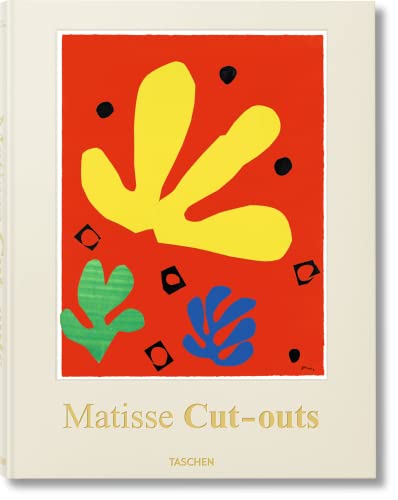
Henri Matisse. Cut-outs. Drawing With Scissors

Product Description
Henri Matisse. Cut-outs. Drawing With Scissors
<div id="description_text_headlines"> <div> <strong>Drawing with scissors: The revolutionary late-period work by Matisse</strong></div> <div>  </div> </div> <div id="description_text"> Towards the end of his monumental career as a painter, sculptor, and lithographer, an elderly, sickly Matisse was unable to stand and use a paintbrush for a longer period of time. In this late phase of his life—he was almost 80 years of age—he developed the technique of ‘carving into color’, creating bright, bold paper cut-outs. Though dismissed by some contemporary critics as the folly of a senile old man, these <em>gouaches decoupées</em> (gouache cut-outs) in fact represented a revolution in modern art, a <strong>whole new medium that re-imagined the age-old conflict between color and line</strong>.<br /> <br /> This <strong>fresh, standard TASCHEN edition of our original prize-winning XL volume</strong> provides a thorough historical context to Matisse’s cut-outs, tracing their roots in his 1930 trip to Tahiti, through to his final years in Nice. It includes many photos of Matisse, some rare color images, by <strong>Henri Cartier-Bresson, Brassaï</strong>, and the filmmaker <strong>Murnau </strong>and text from <strong>Matisse, Picasso,</strong> publisher <strong>E. Tériade</strong>, the poets <strong>Louis Aragon, Henri Michaux</strong>, and <strong>Pierre Reverdy</strong>, and <strong>Matisse’s son-in-law, Georges Duthuit</strong>.<br /> <br /> In their deceptive simplicity, the cut-outs achieved both <strong>a sculptural quality and an early minimalist abstraction which would profoundly influence generations of artists to come</strong>. Exuberant, multi-hued, and often grand in scale, these works are true pillars of 20th century art, and as bold and innovative to behold today as they were in Matisse’s lifetime.</div>
Technical Specifications
You might also like

Henri Matisse: The Cut-Outs

Rothko: The Color Field Paintings

Jean-Michel Basquiat XXL

Gustav Klimt: Complete Paintings XL

Hilma af Klint: Paintings for the Future

Peter Lindbergh: A Different Vision on Fashion Photography (Multilingual Edition)

De Kooning: A Retrospective

Chic Stays (Classics)

Picasso Sculpture

Art of the 20th Century