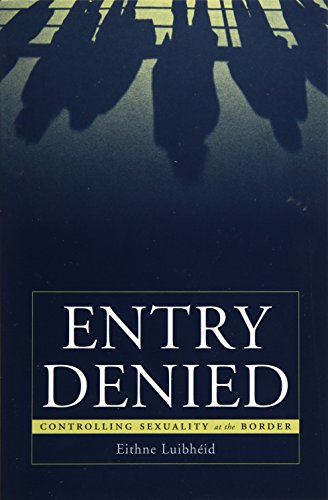
Entry Denied: Controlling Sexuality At The Border
Product Description
Entry Denied: Controlling Sexuality At The Border
- Used Book in Good Condition
Lesbians, prostitutes, women likely to have sex across racial lines, "brought to the United States for immoral purposes, " or "arriving in a state of pregnancy" -- national threats, one and all. Since the late nineteenth century, immigrant women's sexuality has been viewed as a threat to national security, to be contained through strict border-monitoring practices. By scrutinizing this policy, its origins, and its application, Eithne Luibheid shows how the U.S. border became a site not just for controlling female sexuality but also for contesting, constructing, and renegotiating sexual identity.<p>Initially targeting Chinese women, immigration control based on sexuality rapidly expanded to encompass every woman who sought entry to the United States. The particular cases Luibheid examines -- efforts to differentiate Chinese prostitutes from wives, the 1920s exclusion of Japanese wives to reduce the Japanese-American birthrate, the deportation of a Mexican woman on charges of lesbianism, the role of rape in mediating women's border crossings today -- challenge conventional accounts that attribute exclusion solely to prejudice or lack of information. This innovative work clearly links sexuality-based immigration exclusion to a dominant nationalism premised on sexual, gender, racial, and class hierarchies.
Technical Specifications
You might also like

Normal Life: Administrative Violence, Critical Trans Politics, and the Limits of Law

Queer Migrations: Sexuality, U.S. Citizenship, and Border Crossings
Impossible Subjects: Illegal Aliens and the Making of Modern America (Politics and Society in Modern America)

Borderlands/La Frontera: The New Mestiza, Fourth Edition

Rain God

They Called Them Greasers: Anglo Attitudes toward Mexicans in Texas, 1821–1900

The Flower in the Skull
Women Crossing Boundaries: A Psychology of Immigration and Transformations of Sexuality

Cultural Psychology of Immigrants
Latina Realities: Essays on Healing, Migration, and Sexuality (New Directions in Theory and Psychology)