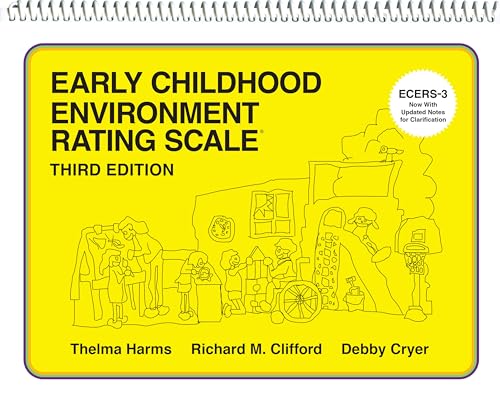
Early Childhood Environment Rating Scale (ECERS-3)
Product Description
Early Childhood Environment Rating Scale (ECERS-3)
<p>The long-anticipated new version of the internationally recognized <em>Early Childhood Environment Rating Scale</em><em><sup>®</sup></em>, <strong>ECERS-3</strong>, focuses on the full range of needs of preschool- and kindergarten-aged children. This widely used, comprehensive assessment tool measures both environmental provisions and teacher–child interactions that affect the broad developmental needs of young children, including:</p> <ul> <li> Cognitive </li> <li> Social-emotional </li> <li> Physical </li> <li> Health and safety</li> </ul> <p>ECERS-3 also includes additional Items assessing developmentally appropriate literacy and math activities.</p> <p>Designed for preschool, kindergarten, and child care classrooms serving children 3 through 5 years of age, <strong>ECERS-3</strong>: </p> <ul> <li> Provides a smooth transition for those already using ECERS-R.</li> <li> Emphasizes the role of the teacher in creating an environment conducive to developmental gains.</li> <li> Is designed to predict child outcomes more accurately and with greater precision.</li> <li> Provides a stronger method of distinguishing between good and truly excellent programs.</li> <li> Offers a complete training program with ongoing support available at the Environment Rating Scales Institute (ERSI) website (www.ersi.info). </li> </ul> <p><strong>ECERS-3</strong> is appropriate for state and district-wide QRIS and continuous improvement; program evaluation by directors and supervisors; teacher self-evaluation; monitoring by agency staff; and teacher education. The established reliability and long term evidence of validity of the ERS family of instruments make this new version of ECERS particularly useful for RTTT-ELC accountability and research. </p> <p>Suitable for use in inclusive and culturally diverse programs, <strong>ECERS-3</strong> subscales evaluate:</p> <ul> <li> Space and Furnishings</li> <li> Personal Care Routines</li> <li> Language and Literacy</li> <li> Learning Activities</li> <li> Interaction</li> <li> Program Structure</li></ul>
Technical Specifications
You might also like

Infant/Toddler Environment Rating Scale (ITERS-3)

School-Age Care Environment Rating Scale Updated (SACERS)

Coaching with ECERS: Strategies and Tools to Improve Quality in Pre-K and K Classrooms

Infant/Toddler Environment Rating Scale (ITERS-R): Revised Edition

Program Administration Scale (PAS): Measuring Early Childhood Leadership and Management
The Art of Awareness, Second Edition: How Observation Can Transform Your Teaching (NONE)

Developmentally Appropriate Practice in Early Childhood Programs Serving Children from Birth Through Age 8

Developmentally Appropriate Practice: Curriculum and Development in Early Education

Family Child Care Environment Rating Scale (FCCERS-3)

Seeing Young Children with New Eyes