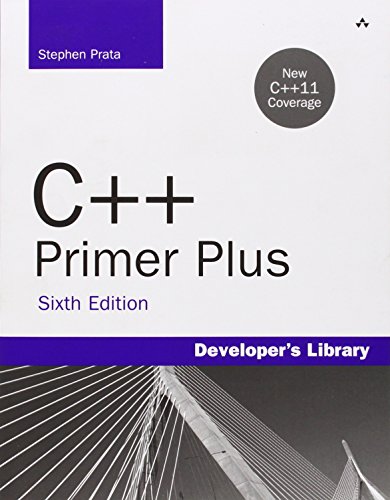
C++ Primer Plus
Product Description
C++ Primer Plus
- 100% Satisfaction Guarantee. Tracking provided on most orders. Buy with Confidence!
- A brand-new, unused, unopened item in its original packaging, with all original packaging materials included.
- Lowest price on amazon!
<p style="margin: 0px;"> <b>C++ Primer Plus, Sixth Edition</b> </p> <p style="margin: 0px;">New C++11 Coverage</p> <i> <br> </i> <i>C++ Primer Plus</i> is a carefully crafted, complete tutorial on one of the most significant and widely used programming languages today. An accessible and easy-to-use self-study guide, this book is appropriate for both serious students of programming as well as developers already proficient in other languages.<br> <br>The sixth edition of <i>C++ Primer Plus</i> has been updated and expanded to cover the latest developments in C++, including a detailed look at the new C++11 standard.<br> <br>Author and educator Stephen Prata has created an introduction to C++ that is instructive, clear, and insightful. Fundamental programming concepts are explained along with details of the C++ language. Many short, practical examples illustrate just one or two concepts at a time, encouraging readers to master new topics by immediately putting them to use. <br> <br>Review questions and programming exercises at the end of each chapter help readers zero in on the most critical information and digest the most difficult concepts.<br> <br>In <i>C++ Primer Plu</i>s, you’ll find depth, breadth, and a variety of teaching techniques and tools to enhance your learning:<br> <ul> <li>A new detailed chapter on the changes and additional capabilities introduced in the C++11 standard</li> <li>Complete, integrated discussion of both basic C language and additional C++ features</li> <li>Clear guidance about when and why to use a feature</li> <li>Hands-on learning with concise and simple examples that develop your understanding a concept or two at a time</li> <li>Hundreds of practical sample programs</li> <li>Review questions and programming exercises at the end of each chapter to test your understanding</li> <li>Coverage of generic C++ gives you the greatest possible flexibility</li> <li>Teaches the ISO standard, including discussions of templates, the Standard Template Library, the string class, exceptions, RTTI, and namespaces</li> </ul> <b>Table of Contents</b> <br> <br> <p style="margin: 0px;">1: Getting Started with C++ <br> </p> <p style="margin: 0px;">2: Setting Out to C++<br> </p> <p style="margin: 0px;">3: Dealing with Data<br> </p> <p style="margin: 0px;">4: Compound Types <br> </p> <p style="margin: 0px;">5: Loops and Relational Expressions<br> </p> <p style="margin: 0px;">6: Branching Statements and Logical Operators<br> </p> <p style="margin: 0px;">7: Functions: C++’s Programming Modules<br> </p> <p style="margin: 0px;">8: Adventures in Functions</p> <p style="margin: 0px;">9: Memory Models and Namespaces</p> <p style="margin: 0px;">10: Objects and Classes</p> <p style="margin: 0px;">11: Working with Classes</p> <p style="margin: 0px;">12: Classes and Dynamic Memory Allocation</p> <p style="margin: 0px;">13: Class Inheritance</p> <p style="margin: 0px;">14: Reusing Code in C++</p> <p style="margin: 0px;">15: Friends, Exceptions, and More</p> <p style="margin: 0px;">16: The string Class and the Standard Template Library</p> <p style="margin: 0px;">17: Input, Output, and Files</p> <p style="margin: 0px;">18: The New C++11 Standard</p> <p style="margin: 0px;">A Number Bases<br> </p> <p style="margin: 0px;">B C++ Reserved Words<br> </p> <p style="margin: 0px;">C The ASCII Character Set<br> </p> <p style="margin: 0px;">D Operator Precedence<br> </p> <p style="margin: 0px;">E Other Operators<br> </p> <p style="margin: 0px;">F The stringTemplate Class<br> </p> <p style="margin: 0px;">G The Standard Template Library Methods and Functions<br> </p> <p style="margin: 0px;">H Selected Readings and Internet Resources<br> </p> <p style="margin: 0px;">I Converting to ISO Standard C++<br> </p> J Answers to Chapter Reviews
Technical Specifications
You might also like

C Primer Plus (6th Edition) (Developer's Library)

Thinking in Java (4th Edition)

C++ Primer (5th Edition)

The C++ Programming Language, 4th Edition
C Programming Language, 2nd Edition

Effective Modern C++: 42 Specific Ways to Improve Your Use of C++11 and C++14

Effective C++: 55 Specific Ways to Improve Your Programs and Designs (3rd Edition)
C++ in One Hour a Day, Sams Teach Yourself (8th Edition)

Programming: Principles and Practice Using C++ (2nd Edition)

Programming in C (4th Edition) (Developer's Library)