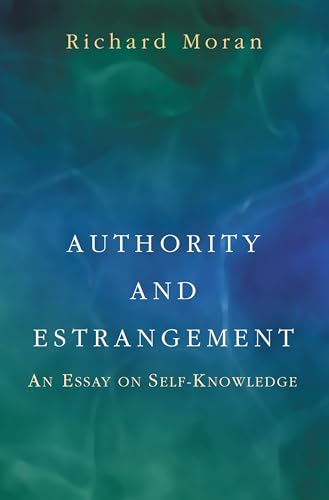
Authority and Estrangement: An Essay on Self-Knowledge.

Product Description
Authority and Estrangement: An Essay on Self-Knowledge.
- Used Book in Good Condition
<p>Since Socrates, and through Descartes to the present day, the problems of self-knowledge have been central to philosophy's understanding of itself. Today the idea of ''first-person authority''--the claim of a distinctive relation each person has toward his or her own mental life--has been challenged from a number of directions, to the point where many doubt the person bears any distinctive relation to his or her own mental life, let alone a privileged one. In <i>Authority and Estrangement</i>, Richard Moran argues for a reconception of the first-person and its claims. Indeed, he writes, a more thorough repudiation of the idea of privileged inner observation leads to a deeper appreciation of the systematic differences between self-knowledge and the knowledge of others, differences that are both irreducible and constitutive of the very concept and life of the person.</p> <p>Masterfully blending philosophy of mind and moral psychology, Moran develops a view of self-knowledge that concentrates on the self as agent rather than spectator. He argues that while each person does speak for his own thought and feeling with a distinctive authority, that very authority is tied just as much to the disprivileging of the first-person, to its specific possibilities of alienation. Drawing on certain themes from Wittgenstein, Sartre, and others, the book explores the extent to which what we say about ourselves is a matter of discovery or of creation, the difficulties and limitations in being ''objective'' toward ourselves, and the conflicting demands of realism about oneself and responsibility for oneself. What emerges is a strikingly original and psychologically nuanced exploration of the contrasting ideals of relations to oneself and relations to others.</p>
Technical Specifications
You might also like

Evidence and Agency: Norms of Belief for Promising and Resolving
Self-Knowledge (Oxford Readings in Philosophy)

Intention

The Story of My Life: Narrative and Self-Understanding (Aquinas Lecture)

Self-Knowledge (New Problems of Philosophy)

Phenomenology of Spirit

Critique of Pure Reason (The Cambridge Edition of the Works of Immanuel Kant)

Self-Constitution: Agency, Identity, and Integrity

Who Knew?: Responsibility Without Awareness

Spheres Of Justice: A Defense Of Pluralism And Equality