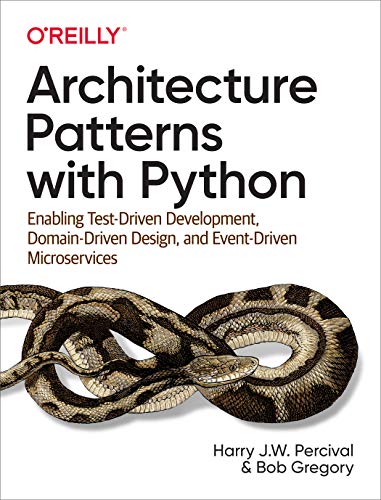
Architecture Patterns with Python: Enabling Test-Driven Development, Domain-Driven Design, and Event-Driven Microservices

Product Description
Architecture Patterns with Python: Enabling Test-Driven Development, Domain-Driven Design, and Event-Driven Microservices
<div><p>As Python continues to grow in popularity, projects are becoming larger and more complex. Many Python developers are now taking an interest in high-level software design patterns such as hexagonal/clean architecture, event-driven architecture, and the strategic patterns prescribed by domain-driven design (DDD). But translating those patterns into Python isn't always straightforward.</p><p>With this hands-on guide, Harry Percival and Bob Gregory from MADE.com introduce proven architectural design patterns to help Python developers manage application complexity-and get the most value out of their test suites.</p><p>Each pattern is illustrated with concrete examples in beautiful, idiomatic Python, avoiding some of the verbosity of Java and C# syntax. Patterns include:</p><ul><li>Dependency inversion and its links to ports and adapters (hexagonal/clean architecture)</li><li>Domain-driven design's distinction between entities, value objects, and aggregates</li><li>Repository and Unit of Work patterns for persistent storage</li><li>Events, commands, and the message bus</li><li>Command-query responsibility segregation (CQRS)</li><li>Event-driven architecture and reactive microservices</li></ul></div>
Technical Specifications
You might also like

Python for DevOps: Learn Ruthlessly Effective Automation
Using Asyncio in Python: Understanding Python's Asynchronous Programming Features

Fundamentals of Software Architecture: An Engineering Approach
Hands-On Machine Learning with Scikit-Learn, Keras, and TensorFlow: Concepts, Tools, and Techniques to Build Intelligent Systems

Effective Python: 90 Specific Ways to Write Better Python (2nd Edition) (Effective Software Development Series)
Monolith to Microservices: Evolutionary Patterns to Transform Your Monolith

Kubernetes: Up and Running: Dive into the Future of Infrastructure

Data Science from Scratch: First Principles with Python

gRPC: Up and Running: Building Cloud Native Applications with Go and Java for Docker and Kubernetes

Fluent Python: Clear, Concise, and Effective Programming